The Marriage Portrait: History, the Novel, and Art That Lasts
There is a painting of a young girl in the North Carolina Museum of Art. She is about fifteen years old. She wears the jewels of two powerful families. Her expression is not proud or serene the way Renaissance subjects are supposed to look. She looks worried. She looks frightened.
Her name was Lucrezia de' Medici, and she died less than a year after that portrait was made.
That painting, and the short life behind it, inspired Maggie O'Farrell to write one of the most celebrated novels of recent years. But "the marriage portrait" as a subject runs much deeper than any single book. It reaches back through five hundred years of art history, through the politics of power and love and survival, all the way to the present, where couples still commission portraits to mark the most important day of their lives.
The tradition never died. It just changed hands.
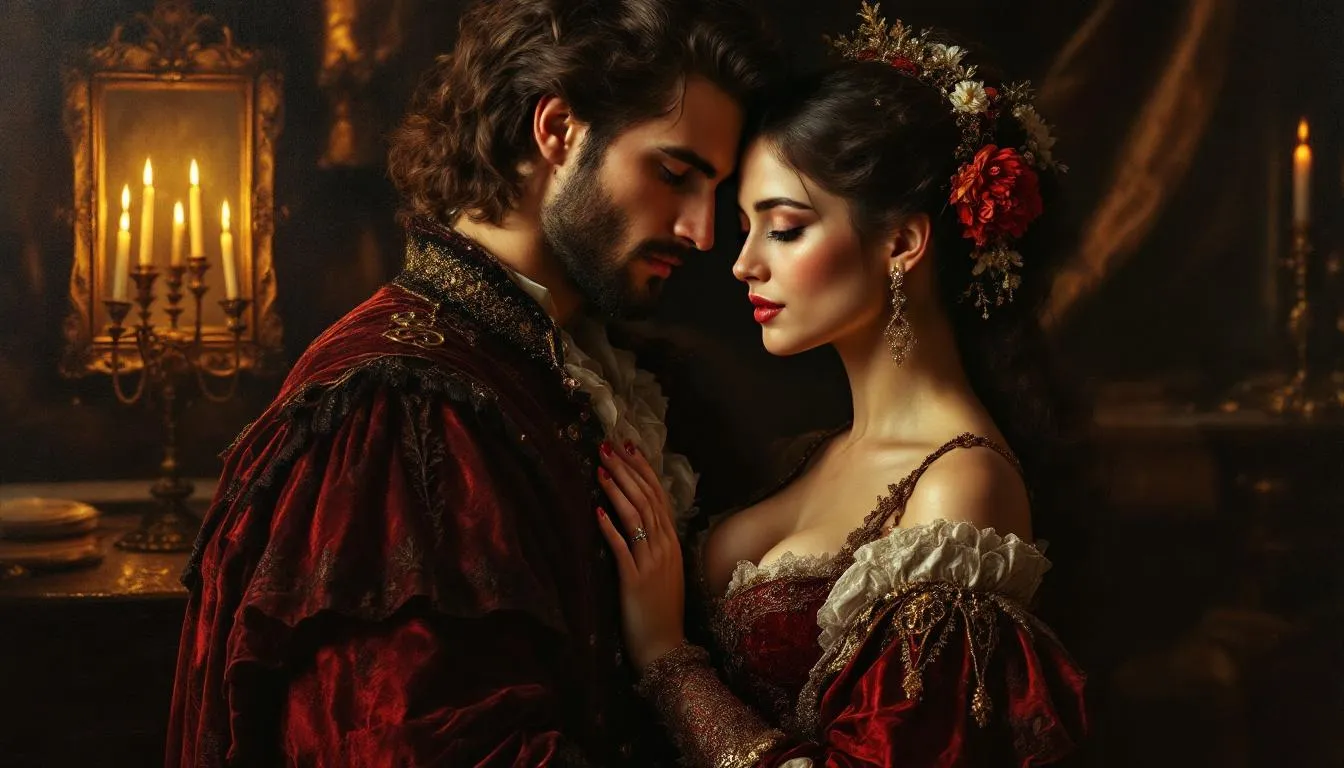
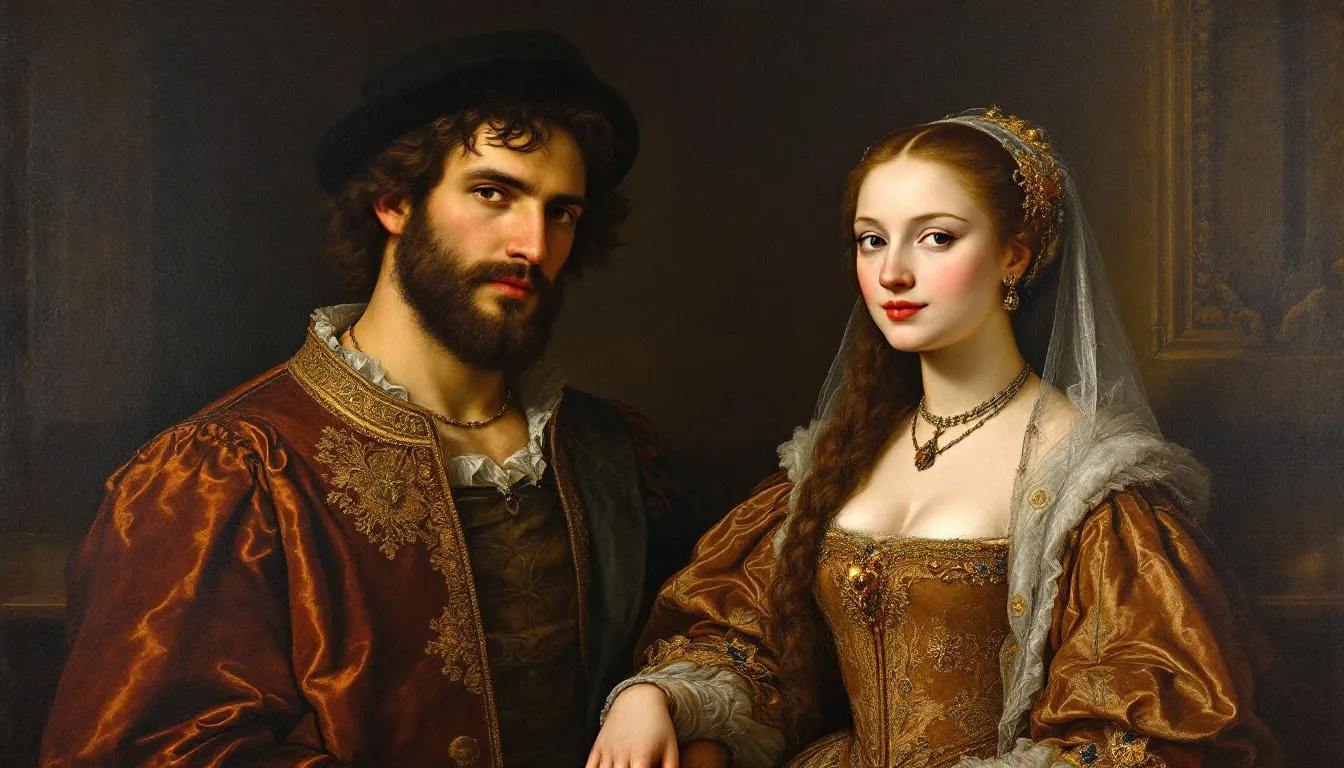
Today, instead of a duke dispatching a painter to assess a potential bride, couples order custom portraits as wedding gifts, anniversary surprises, and keepsakes built to last longer than the flowers on the table. Companies like Fable have made this possible at a scale the Renaissance aristocracy could never have imagined, bringing the gravity and beauty of classical portrait art to anyone with a photograph and a story worth telling. A couple portrait from Fable renders two people in the style of the great masters, painted in digital oils, printed large enough to hang over a fireplace. It is the same impulse that drove the Medici family to commission portraits in the first place: to say, these people matter, and we want the record to show it.
That impulse is what this article is about. The novel. The history. The real Lucrezia. The tradition of the marriage portrait from Florence to the present. And the question that ties all of it together: why do we keep wanting to be painted?
What is "The Marriage Portrait"?
Maggie O'Farrell published "The Marriage Portrait" in September 2022. It became a New York Times bestseller, a Reese's Book Club selection, and was shortlisted for the 2023 Women's Prize for Fiction. If you have not read it yet, the short version is this: it is a novel about a young woman who realizes, with quiet horror, that her husband is going to kill her.
The longer version is considerably richer.
The plot
The novel centers on Lucrezia de' Medici, the fifth child of Cosimo I, Grand Duke of Tuscany. She is intelligent, artistic, and overlooked. The marriage was not originally meant for her. Her older sister Maria was betrothed to Alfonso II d'Este, Duke of Ferrara. When Maria died suddenly, the Este family requested a replacement. The Medicis offered Lucrezia. She was thirteen years old.
O'Farrell structures the novel across two interweaving timelines. One follows the slow lead-up to the marriage and the portrait that was commissioned in its wake. The other is set in a hunting lodge, a single night of terrible clarity in which Lucrezia studies her husband's face and understands what he has brought her there to do. The present-tense timeline is wound tight with dread. Every paragraph feels like a held breath.
The novel ends with a twist that O'Farrell earned. Without giving too much away, Lucrezia does not die the way history says she did. In O'Farrell's telling, survival is an act of imagination and will. The real Lucrezia had neither the resources nor, perhaps, the warning. O'Farrell gives them to her.
Where the idea came from
O'Farrell has spoken in multiple interviews about the starting point for the novel. It was not the historical record. It was a poem.
Robert Browning wrote "My Last Duchess" in 1842. It is a dramatic monologue spoken by a Renaissance duke who shows a visitor the portrait of his late wife. The duke describes her warmth, her pleasure in simple things, the way she smiled at everyone. Then he mentions, almost in passing, that he gave some commands and her smiles stopped altogether. The poem ends. The implication is unmistakable.
Browning based his duke on Alfonso II d'Este. His duchess on Lucrezia de' Medici.
O'Farrell read "My Last Duchess" and felt the usual chill. But then she began to wonder: what was she actually like? The woman behind the painting, the poem, the duke's cold narration. What did she think? What did she feel? What would she have done if she had known?
She found Lucrezia's actual portrait at the North Carolina Museum of Art. The moment she saw it was, she said, like a lightning bolt. The girl in the painting looked so worried and apprehensive. Not the composed, slightly remote expression you expect from a Renaissance noblewoman. Something raw and present and frightened.
That face launched a novel.
The critical reception
The book received the kind of reviews that authors frame and hang on walls. Ron Charles of the Washington Post wrote that "O'Farrell creeps into this gloomy realm of intrigue with an inkwell full of blood and a stiletto for her pen." Critics praised the prose, the structure, the way O'Farrell made a five-hundred-year-old story feel immediate and urgent. Readers who came for the historical fiction stayed for the emotional wallop.
The shortlisting for the Women's Prize for Fiction felt appropriate. "The Marriage Portrait" is, at its core, a story about a woman fighting for the right to exist. The portrait in the title is not just a painting. It is proof of presence. It is Lucrezia's refusal to be defined entirely by the men who arranged her life.
The real Lucrezia de' Medici
The historical record is thinner and sadder than the novel. Lucrezia de' Medici was born on February 14, 1545, the fifth child of Cosimo I and Eleonora di Toledo. She was known for her skill in painting and music. She was, by most accounts, a bright and curious child.
The marriage negotiation began when she was still very young. Her sister Maria was the original intended bride for Alfonso d'Este. When Maria died of a sudden illness in November 1557, Alfonso asked for another Medici daughter. Lucrezia was chosen. She was thirteen.
The wedding took place on July 3, 1558, in Florence. Alfonso was twenty-four. She moved to Ferrara with her new husband and, by most historical accounts, struggled from the start.
She died on April 21, 1561. She was sixteen years old.
The cause of death recorded was a month of fever, dramatic weight loss, and constant coughing. Most medical historians who have examined the case accept pulmonary tuberculosis as the most likely explanation. The disease was common, the symptoms consistent, the timeline plausible.
But Alfonso had already begun negotiating his next marriage before Lucrezia died.
That detail has shadowed his reputation for four and a half centuries.
The rumor of poisoning
Rumors circulated almost immediately after Lucrezia's death. She was young. She had been healthy enough to marry. The speed of her decline, and the speed with which Alfonso moved on, fed whispers that she had been helped along.
No definitive evidence of poisoning has ever been found. Alfonso went on to marry twice more. Neither of his subsequent wives died under mysterious circumstances. Most historians conclude that Lucrezia simply died of tuberculosis, a disease that killed many people in the sixteenth century, and that Alfonso's swift remarriage was political necessity rather than evidence of guilt.
But Browning did not find that conclusion satisfying. Neither did O'Farrell.
Neither, if we are honest, do most readers.
The portrait
The portrait that O'Farrell saw, the one that stopped her cold, was painted by Alessandro Allori around 1560. Allori was a Florentine painter, a student of Bronzino, skilled in the cool, slightly formal style of the Medici court.
In the painting, Lucrezia is approximately fifteen years old. She wears an elaborate gown and significant jewelry, pieces that carry the insignia of both the Medici and Este families. She is dressed to represent a diplomatic alliance. The clothes announce her function.
Her face announces something else.
She does not look serene. She does not look proud. She looks young and uncertain and, as O'Farrell immediately perceived, afraid. Whether that interpretation is projected or observed, whether Allori intended it or whether five centuries of knowing what happened next colors what we see, is a question without a clean answer. But the portrait has that quality. It stays with you.
The painting now hangs in the North Carolina Museum of Art in Raleigh. If you want to see the face that launched a novel, that is where to find it.
The Renaissance marriage portrait tradition
To understand why the marriage portrait mattered so much in the fifteenth and sixteenth centuries, you have to understand what it was replacing.
You could not FaceTime a potential bride. You could not see photographs. You could not scroll through her social media and form some rough impression of who she was. If you were a duke or an emperor negotiating a dynastic marriage with a family several days' ride away, you had exactly one tool available for seeing the person you might spend your life with.
You sent for a portrait.
Portraits as diplomatic instruments
This was not a romantic gesture. It was infrastructure.
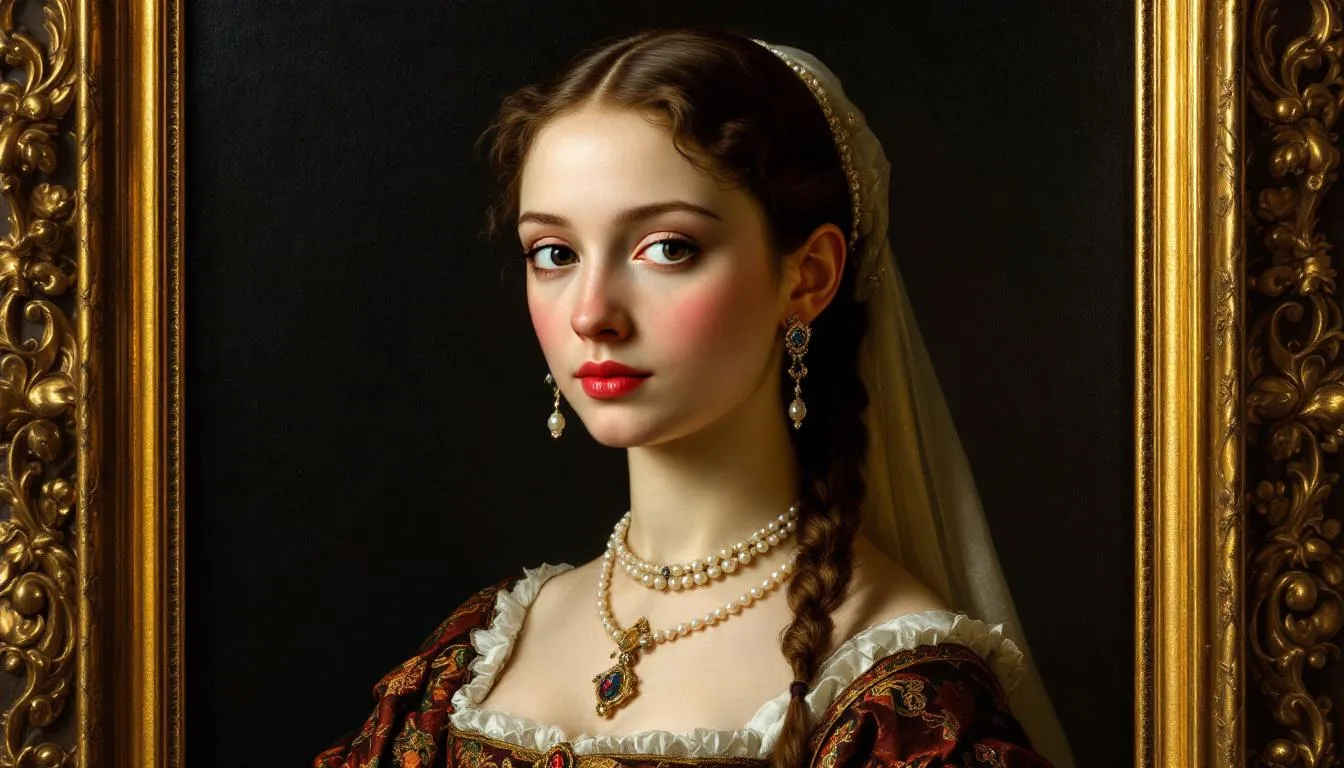
Families relied on painted likenesses to assess potential spouses before they committed to travel, negotiation, or legal agreement. A portrait was due diligence. It communicated age, health, apparent attractiveness, social status, and the family's willingness to invest in presenting their daughter well. A shabby portrait, or a portrait that suggested poor health or unusual features, could end a negotiation before it began.
The Bianca Maria Sforza case from around 1493 illustrates exactly how this worked. Bianca Maria was the niece of Ludovico Sforza, Duke of Milan. Maximilian I, the Holy Roman Emperor, was a potential match. Before any formal agreement was reached, a portrait was commissioned, partly to send to Maximilian's court as evidence of her suitability. The portrait shows a carnation tucked into her belt, a flower that carried a specific symbolic meaning in Renaissance iconography: betrothal. The carnation announced her status before she said a word.
Bianca Maria married Maximilian by proxy. She did not meet him in person for seven months.
The portrait did her introduction for her.
The conventions of the betrothal portrait
Renaissance painters developed a recognizable visual language for marriage portraits, and it is worth knowing that language because it shows up everywhere once you learn to read it.
Early in the fifteenth century, the profile pose dominated. This was borrowed deliberately from ancient Roman coins and medals, which depicted rulers in strict profile. The association was intentional: a woman in profile was being presented as a kind of currency, a person of value being offered in exchange for political alliance.
By the late fifteenth century, the three-quarter view had largely replaced the profile. It felt more natural, more present, more like a real person and less like a coin. The shift coincided with a broader change in how Renaissance portraiture was thinking about interiority, the idea that a portrait should capture not just a face but something of the person behind it.
Women in betrothal portraits were typically shown wearing clothing and jewelry that their intended husband had given them, or that signaled his wealth and status. The clothes were not just clothes. They were a message: this man is rich enough to dress you this way. This alliance will be worth your family's while.
Symbolic flowers appear constantly. Carnations for betrothal. Pearls for purity. Orange blossoms for fertility. The paintings are full of a visual vocabulary that contemporary viewers knew how to decode and that most of us need a footnote to understand.
Paired portraits and diptychs
Some of the most striking marriage portraits were created as pairs, two paintings designed to hang together and to be read together. The most famous example is Piero della Francesca's diptych of Federico da Montefeltro and Battista Sforza, painted around 1473 to 1475 and now held at the Uffizi in Florence.
The two panels face each other. Federico's profile on one side, Battista's on the other. The landscape behind them is continuous, which means when the panels are placed together, the two figures share a single horizon. They are joined by the world they inhabit.
Battista had already died by the time Piero painted the diptych. Federico had it made as an act of memorial and love, and perhaps as a public statement about the dynasty they had built together. Her portrait was painted from her death mask.
Even in death, the marriage portrait asserted connection.
Isabella d'Este and the politics of self-presentation
Not every marriage portrait was made at someone else's request. Some subjects commissioned their own, and in doing so, took control of how they would be seen.
Isabella d'Este was Marchioness of Mantua and one of the most powerful women in Renaissance Italy. She was a collector, a patron of the arts, a diplomat, and a relentless self-promoter in the best possible sense. When she commissioned Titian to paint her portrait around 1534 to 1536, she was sixty-two years old. She had been a major political figure for decades.
She sent him a painting of herself as a young woman and told him to use it as the basis for his work.
Titian painted her as she had been, not as she was. The portrait shows a woman of perhaps twenty-five, rich and beautiful and at the height of her power. It is a portrait of how Isabella wanted to be remembered, which is a different thing from how she actually looked.
This is the fascinating power dynamic of the commissioned portrait. The subject has opinions. The subject can push back. The subject can say: no, that is not how I want to be seen. Paint me differently.
Isabella understood something that most people understand intuitively: a portrait is not a photograph. It is an argument.
Sofonisba Anguissola and women behind the brush
Most Renaissance portraits were painted by men. But not all of them.
Sofonisba Anguissola was born around 1532 in Cremona and became the first female artist of the Renaissance to achieve genuine international fame. She was primarily a portraitist. Philip II of Spain appointed her as a court painter and later as a lady-in-waiting to his queen. She painted members of the Spanish royal family. Her work was admired by Michelangelo.
She lived to approximately ninety-three years old. Anthony van Dyck visited her when she was very elderly and still painting, and he wrote admiringly about both her skill and her sharp eye.
Her existence in this story matters because the narrative of the marriage portrait is so often a narrative about women being assessed, catalogued, sent to courts like diplomatic packages. Anguissola was on the other side of the canvas. She was the one with the brush, the one making the choices about how people were depicted. Her presence in Renaissance art history is a counterweight to all those paintings of young women in borrowed jewelry, wearing symbols they may or may not have chosen for themselves.
The portrait as an act of assertion
One of the central ideas in O'Farrell's novel is that sitting for a portrait, being painted, is an act of agency. Even when you have no control over your circumstances, even when you have been bartered and married and moved across the country to a husband you barely know, the moment of being painted is yours. You are the subject. You are the one being recorded. In that moment, however briefly, you exist on your own terms.
O'Farrell has said in interviews that this is one of the things that drew her to the story. The portrait in the novel title is a double meaning. There is the literal portrait of Lucrezia that was painted. And there is the portrait that O'Farrell herself paints in the novel, the full-length, full-color record of a young woman who was otherwise almost entirely absent from history.
That tension, between the decorative self that the marriage portrait was meant to present and the real self underneath, runs through everything. It runs through Isabella d'Este demanding a younger face. It runs through the worried expression on Lucrezia's face that Allori may or may not have intended. It runs through Browning's poem, in which the duke's description of his wife is so full of involuntary admiration that his contempt for her cannot fully contain it.
The portrait remembers things the painter did not mean to record.
This is why people have always wanted portraits made. Not just to document. Not just to signal status. But to say: I was here. I was real. I looked like this.
From Florence to now: the marriage portrait as a gift tradition
The world has changed. Most of it, anyway.
You no longer need a portrait to assess a potential spouse. The diplomatic function of the betrothal portrait is gone. Nobody is shipping painted panels across international borders to negotiate marriages between dynasties.
But the impulse underneath all of that, the desire to mark love with art, to make something lasting out of something momentous, did not disappear with the Renaissance.
It just changed form.
What the numbers say
The global personalized gifts market was valued at $30.84 billion. It is growing at a compound annual growth rate of 6.61 percent through 2035. That is not a niche market. That is a mainstream preference that has shifted significantly in recent years.
Within that market, home decor and wall art hold the largest category share at 21.8 percent. People are not just buying personalized mugs and keychains. They are commissioning things meant to hang on walls and stay there.
According to data from The Knot, more than sixty percent of wedding guests now choose personalized gifts over standard registry items. The registry used to be the whole point. Now most people would rather give something that cannot be found in a department store.
That shift matters. It says something about what people want from a gift. They want it to mean something specific. They want the recipient to know that someone thought about them, not just about a price point.
Commissioning a portrait as a wedding gift
A custom portrait as a wedding gift reverses the Renaissance dynamic in the most satisfying possible way.
In the fifteenth century, a portrait was commissioned to assess value, to signal alliances, to move a person from one household to another like a piece of very elegant cargo. The portrait served the institution of marriage more than it served the people inside it.
A portrait commissioned as a wedding gift serves the couple. Full stop.
It takes their faces, their particular combination of features and expressions, and renders them in the style of the great masters. It places them in that long tradition of people who mattered enough to be painted. It says: your love is worth commemorating at this scale.
That is a different relationship with the art form. And it is, arguably, the better one.
What Fable does
Fable creates custom portraits in Renaissance, royal, and classical styles from customer photos. The process is simple. You upload a photo, choose a style, and receive a portrait that looks like it was painted by a court artist in sixteenth-century Florence or seventeenth-century Amsterdam. The results are large-format prints, sized for walls, designed to last.
A couple portrait from Fable is the obvious choice for a wedding gift, an anniversary, or a way to mark any milestone that deserves more than a card. It takes something that was once available only to dukes and grand duchesses and makes it available to everyone.
This is not about pretending to be royalty. It is about the genuine human desire to be seen, to be recorded, to have the visual record say: these two people, right now, in this moment. That is what the marriage portrait has always been about. The medium has changed. The meaning has not.
You can also commission family portraits, kids portraits, and self portraits through Fable. But for anyone who has just read O'Farrell's novel, or who has been thinking about the tradition of the marriage portrait and wants to participate in it in a way that honors rather than imitates that history, the couple portrait is where to start.
The portrait as a wedding gift vs. everything else
Think about what most wedding gifts are. They are appliances that will be used for a decade and then replaced. They are serving platters that will come out three times a year. They are gift cards that will be spent on something nobody will remember.
A portrait is different. It gets better with time. It becomes a piece of the couple's home, a fixture on their wall, something their children will grow up looking at. It is the kind of gift that follows people through moves and renovations and life changes, always finding a new wall, always staying.
The anniversary gift portrait has become one of the most searched gift categories for that reason. People are figuring out what portrait givers have known for five hundred years: this is the gift that holds.
If you are looking for a wedding gift that nobody else in the room will give, a portrait is it. If you are thinking about what to give a couple who has been together long enough that they already own most things, a portrait of them as they are right now, rendered in the style of a Renaissance master, is the answer.
It is personal. It is beautiful. It is permanent.
That is a hard combination to beat.
How to commission a marriage portrait today
The process of commissioning a portrait has simplified dramatically since the days of Alessandro Allori and the Medici court. You no longer need to arrange sittings across multiple weeks. You do not need to negotiate with a court painter about whether to depict the pearls of the Este family or the Medici family in your daughter's neckline.
You need a photo and fifteen minutes.
Fable's how it works page walks through the full process. Upload a clear photo of the subject or subjects, select a portrait style (Renaissance, royal, or classical are the main options), and place your order. The portrait is delivered as a high-resolution digital file, print-ready for large formats.
Pricing is transparent and accessible. This is not a luxury service that requires a budget negotiation. It is designed to be the kind of gift a person can give at a wedding or an anniversary without stress.
The prints are large enough to genuinely function as wall art. This is not a novelty postcard or a small print in a frame. The image sizes are built around the assumption that the portrait will be displayed, not tucked in a drawer.
If you want to give something that connects to the five-hundred-year tradition of the marriage portrait, something that honors the gravity of the occasion and the permanence of the love behind it, this is the most direct path to it that currently exists.
The novel and the portrait: what O'Farrell got right
A criticism sometimes leveled at historical fiction is that it retrofits modern sensibilities onto historical people. The argument is that a sixteenth-century girl could not have thought the thoughts O'Farrell gives Lucrezia, could not have had that particular quality of self-awareness and resistance that the novel requires.
It is worth pushing back on that argument.
The desire to survive is not a modern invention. The perception that someone wishes you harm is not a modern cognitive achievement. A young woman who has been bartered into a marriage with an older man who was negotiating her replacement before she was in the ground, that young woman did not need a twenty-first-century education to understand her situation. She needed to be paying attention. And if the portrait that Allori painted of her tells us anything, she was paying attention.
O'Farrell is careful about this. She does not give Lucrezia anachronistic politics or vocabulary. She gives her perception. She gives her the capacity to observe and interpret. Those are not anachronistic qualities. Those are human qualities, and they were just as available in 1560 as they are now.
What the novel does beautifully is take the portrait seriously as a site of meaning. The painting is not just decoration. It is evidence. It is the thing Lucrezia leaves behind that says: she was here, she was frightened, and she saw everything clearly. Whether the historical Lucrezia had time to see it clearly or not, the portrait that Allori made of her carries that impression whether he intended it or not.
Art is strange that way. It keeps telling the truth even when the people involved were trying to manage a narrative.
"My Last Duchess" and what it tells us about portraits
Browning's poem is worth reading alongside the novel. It is short, forty-seven lines, and it is one of the most chilling things in the English language. The duke's narration is so controlled, so careful, so full of unearned pride that it reveals him completely without ever losing its composure.
The portrait in the poem is what he uses to control the narrative. He can show it when he chooses. He can draw a curtain over it when he chooses. He decides who looks at it and who hears the story behind it. The painting has become another instrument of ownership.
What "The Marriage Portrait" does is give Lucrezia back the painting. It makes the portrait hers again. The novel says: we are going to look at this painting, and we are going to hear from the person in it, not from the person who commissioned it. That is the act of recovery at the heart of the book.
It is also, in a quieter way, what all portraiture does when it works. The subject leaks through.
The broader world of portrait gifting
The marriage portrait is the most historically weighted version of the portrait-as-gift, but it is not the only one. The tradition of giving portraits has expanded well beyond weddings and betrothals.
Birthday portrait gifts have become a significant category. A portrait of someone on a milestone birthday is the kind of gift that says you see them, you value them, you want to commemorate this particular version of them at this particular point in their life.
Art gifts for mom are another area where the personalized portrait lands differently than anything else you could give. A portrait of her children, or of the whole family, is not a gift she would buy herself. It requires someone else to think of her in that way.
The tradition has even extended to pets. Pet portraits and royal pet portraits have become genuinely popular, because the same impulse applies. The dog is part of the family. The dog deserves a painting. You can explore the full range at Fable's blog, which covers everything from custom dog portraits to renaissance pet portraits to personalized dog portraits.
If you are thinking about gifts for an engaged couple or looking for Valentine's Day gift ideas for a wife, the personalized portrait consistently outperforms the alternatives in terms of the response it gets. It is not that flowers and chocolates are bad. It is that a portrait is the gift that stays.
The bachelorette gift ideas category and the mother of the bride gift ideas category both point in the same direction: the gifts people remember are the ones that are specific to them. A portrait is specific to the person in it. Nobody else can have yours.
For art lovers specifically, unique gifts for art lovers and gifts for art lovers are categories where a custom portrait really shines. Someone who loves art will genuinely love receiving art that is made for them. It is not a generic print. It is a painting of their face in the style they care about.
The graduation gift art category is another natural fit. A portrait at graduation marks a transition, a before and after. Here is who you were at this moment. Keep it.
Famous Renaissance painters who worked on marriage portraits
The painters who created marriage portraits in the Renaissance were among the most skilled artists of their generation. The commission was prestigious. Getting it wrong had consequences.
Alessandro Allori, who painted Lucrezia de' Medici, trained under Agnolo Bronzino, the official court painter to Cosimo I de' Medici. Bronzino's style was cool, precise, and slightly otherworldly. His subjects looked composed to the point of stillness. They were the visual language of power and restraint. Allori inherited this approach and brought it to the portrait of a girl who was anything but composed.
Piero della Francesca worked for the courts of central Italy throughout the fifteenth century. His diptych of Federico da Montefeltro and Battista Sforza remains one of the most technically accomplished pairings in the history of portraiture. The landscape behind both figures connects them. The inscription on Battista's panel records Federico's military victories. The portrait is as much a political document as it is a work of art.
Titian worked at the highest levels of European society throughout his long career. He painted Holy Roman Emperors and popes and Venetian doges. When Isabella d'Este wanted a portrait that would secure her legacy, she went to him. He was eighty years old before he produced what she wanted.
Raphael painted several important betrothal and marriage portraits during his time in Rome and Florence. His Portrait of Joanna of Aragon from around 1518 was commissioned to mark her betrothal and sent to the French court.
These were not just painters. They were image managers. Reputation architects. The people responsible for how a subject would be seen and remembered.
The tradition they served did not end. It evolved. The court painters became portrait photographers became, now, platforms like Fable that can give anyone access to the same quality of commemorative art.
Why the marriage portrait keeps mattering
History moves fast and art history even faster. The conventions of the Renaissance betrothal portrait, the profile pose, the symbolic carnations, the continuous landscape in a diptych, are specific to a time and place. Nobody sends painted panels across international borders to negotiate marriages anymore.
And yet the marriage portrait endures. It endures because the thing underneath the convention never changed.
People get married and want a record that is more than a photograph. They want something that says: this was important. This was worth commemorating properly. This deserves the same weight and gravity that the Medici family brought to it when they sent Lucrezia across the mountains to marry a duke she had never met.
The difference is that now, the portrait is made for the couple. Not for the alliance. Not for the dynasty. For them.
That is a meaningful shift. It is the difference between a portrait as instrument and a portrait as gift. And it is, I would argue, the reason the tradition survived long after the political circumstances that created it disappeared entirely.
Portraits persist because people want to be seen. They want the record to exist. They want to say, to whatever comes after: we were here, and we looked like this, and it mattered.
That need is as old as painting itself. It will outlast whatever format it finds next.
FAQ: The marriage portrait
What is "The Marriage Portrait" about?
"The Marriage Portrait" is a novel by Maggie O'Farrell, published in September 2022. It tells the story of Lucrezia de' Medici, the fifth child of Cosimo I, Grand Duke of Tuscany, who was married at thirteen to Alfonso II d'Este, Duke of Ferrara. The novel follows Lucrezia as she realizes her husband may intend to kill her, and it ends with a fictional twist in which she survives and escapes to a new life. The book was shortlisted for the 2023 Women's Prize for Fiction.
Was "The Marriage Portrait" based on a real person?
Yes. Lucrezia de' Medici was a real historical figure. She was born on February 14, 1545, married Alfonso II d'Este in 1558 at thirteen, and died on April 21, 1561, at the age of sixteen. Most historians attribute her death to pulmonary tuberculosis. The novel takes the historical record as a starting point and imagines a different ending. Robert Browning's 1842 poem "My Last Duchess" was also based on Alfonso and Lucrezia, and it was Browning's poem that first drew O'Farrell to the story.
What is a Renaissance marriage portrait and what was it used for?
Renaissance marriage portraits were commissioned paintings used to facilitate dynastic matches between families and courts that were geographically distant. Before any formal agreement was reached, one family would commission a portrait of a prospective bride or groom and send it to the other family as a form of visual introduction. The portraits followed specific conventions: symbolic flowers (carnations for betrothal, pearls for purity), clothing that signaled the groom's wealth, and poses influenced by ancient Roman coins and medals. They were diplomatic instruments as much as they were works of art.
Where is Lucrezia de' Medici's actual portrait?
The portrait of Lucrezia de' Medici, painted by Alessandro Allori around 1560, is held at the North Carolina Museum of Art in Raleigh, North Carolina. It shows Lucrezia at approximately fifteen years old, wearing jewelry from both the Medici and Este families. When Maggie O'Farrell first saw the painting, she described the experience as a "lightning bolt," noting that the subject looked worried and apprehensive rather than composed.
Who inspired "My Last Duchess" by Robert Browning?
Robert Browning's 1842 dramatic monologue "My Last Duchess" was inspired by Alfonso II d'Este and Lucrezia de' Medici. In the poem, a Renaissance duke narrates while showing a portrait of his late wife to a visitor, hinting strongly that he arranged her death. Browning based the poem on the historical circumstances of Lucrezia's short marriage and death. The poem was Maggie O'Farrell's entry point into the story that became her novel.
Is "The Marriage Portrait" a good book club read?
Yes. "The Marriage Portrait" was selected for Reese's Book Club and performs well in group discussion settings because it raises questions about power, survival, the reliability of historical narratives, and the role of art in recording lives. The tension between what the historical record says and what O'Farrell imagines gives readers a lot to discuss about the ethics of historical fiction, the gaps in women's history, and the way art can outlast and reshape the stories told about its subjects.
What is a marriage portrait as a gift?
A marriage portrait as a gift is a custom commissioned portrait of a couple, typically given to mark a wedding or anniversary. The tradition connects to the Renaissance practice of celebrating important relationships with painted portraits, but in its contemporary form, it shifts the meaning entirely: instead of a portrait that serves diplomatic or dynastic purposes, it is an act of love and commemoration. Fable's couple portraits are a modern version of this tradition, rendered in Renaissance and classical styles from customer photos.
How long did it take Maggie O'Farrell to write "The Marriage Portrait"?
O'Farrell has noted in interviews that research for the book was extensive, covering the history of the Medici and Este families, Renaissance art, and the specific circumstances of Lucrezia's life and death. She visited Florence and Ferrara, mapped the castello, and laid flowers on Lucrezia's grave in a monastery there. The novel was published in September 2022, following O'Farrell's previous novel "Hamnet" (2020), which won the Women's Prize for Fiction.
Related guides
- Wedding gift art: portrait ideas that will actually be kept
- Anniversary gift portraits: the complete guide
- Gift ideas for an engaged couple that go beyond the registry
- Unique gifts for art lovers
- Valentine's Day gift ideas for a wife
Sources
- Lucrezia de' Medici - Wikipedia
- Portrait of Lucrezia de' Medici - North Carolina Museum of Art
- My Last Duchess - Wikipedia
Lucrezia de' Medici sat for a portrait in the last year of her life. She was fifteen years old, dressed in jewelry that announced her value to two powerful families. She looked at the painter. He looked back.
Whatever she was thinking, whatever she felt, Allori recorded enough of it that a novelist four hundred and sixty years later could see it across a museum gallery and feel the need to write a book about it. That is what a good portrait does. It preserves something real. It keeps the subject alive past the end of their life, past the end of their story, past whatever was done to them or taken from them.
That is why the marriage portrait has never really gone out of fashion. The medium changed. The context changed. The politics changed completely. But the impulse did not: we want the people we love to be seen. We want the record to exist. We want to say, to whatever comes after: we were here, and we looked like this, and it mattered.
Fable makes it possible to create that kind of record today. A couple portrait, a family portrait, a self portrait in the style of the Renaissance masters. Not a novelty. Not a costume. A genuine piece of wall art that carries the weight of an old tradition and the specific, irreplaceable face of someone you love.
Start with a photo. End with something that lasts.
See how Fable works or browse portrait styles and pricing to find the right fit.