
Abstract self portrait: the complete guide
Every face tells a story. But the most honest portraits rarely look like the person at all.
That's the paradox at the heart of the abstract self portrait. Artists from Picasso to Frida Kahlo to Jean-Michel Basquiat have all wrestled with the same question: how do you paint yourself when your inner life doesn't fit inside a realistic face? The answer, it turns out, is to stop trying to be accurate. To break the rules. To let color, shape, fragmentation, and symbol carry what a photograph never could.
This guide covers everything you need to know about abstract self portraits. We'll look at the history, the most iconic examples, the psychology behind why people make them, and the practical techniques you can use yourself. Whether you want to hang something meaningful on your wall, process a complicated year, or simply try something creative, you'll find a path forward here.
But first, the easiest place to start.
The portrait you commission before you pick up a brush
Before you spend an afternoon wrestling with acrylic paint or collage paper, consider this: the most striking portrait you can own of yourself might not be one you make at all. It might be one made for you.
Fable transforms your photo into a museum-quality portrait in the style of the old masters. Renaissance. Royal. Classical. Your face rendered with the gravity and beauty of 16th-century oil painting. No artistic skill required. Just a clear photograph and a few minutes of your time.
The Fable self portrait is the version of you that the history books would have painted. It's the kind of image that stops people in their tracks when they see it on the wall. It's heirloom art, made from a selfie.
This is the starting point for anyone who wants a portrait that feels genuinely significant. Check how it works and pricing to understand what's involved. Then, if you want to go further and make something with your own hands, the rest of this guide is for you.
What is an abstract self portrait?
A self-portrait is any work where the artist depicts themselves. An abstract self-portrait is any self-portrait that moves away from accurate, photorealistic representation toward something more expressive, symbolic, or fragmented.
The key word is intent. The creator and the subject are the same person. But the way that person is shown can range from slightly stylized to completely unrecognizable. You might see a face rendered in geometric planes with no natural color. You might see a silhouette built from collaged magazine pages. You might see a painting where the "self" exists only as gesture and brushstroke, with no literal face at all.
Abstract self-portraiture covers a wide spectrum. On one end, you have works like Egon Schiele's brutally distorted self-portraits from 1910 to 1918, which remain clearly figurative but warp the body into psychological states. On the other end, you have the abstract expressionists, whose self-expression is embedded in the act of painting itself, not in any recognizable image.
What unites them all is the decision to prioritize inner truth over outer likeness.
A photograph shows what you look like. An abstract self-portrait shows who you are, or who you're afraid you are, or who you wish you were. That distinction matters. It's the reason this particular form of art has captivated serious artists for over a century and continues to resonate with anyone who picks up a brush, camera, or pair of scissors.
A brief history: how the abstract self portrait evolved
The tradition of self-portraiture is old. The oldest verified self-portrait in the Western canon is a 1484 silverpoint drawing by a 13-year-old Albrecht Dürer. But the abstract self-portrait is a 20th-century invention, born from the collision of artistic movements that were all, in different ways, trying to paint what couldn't be photographed.
Cubism and the shattered face
In 1907, Pablo Picasso painted two works that changed everything. "Les Demoiselles d'Avignon" launched Cubism as a movement. His "Self-Portrait" of the same year applied the same logic to his own face: geometric planes, fractured forms, thick black lines where features should be. It was the first major abstract self-portrait in the modern canon.
Cubism's core insight was that you don't need to show a face from one angle. You can show it from every angle at once. Profile and frontal view coexist. The nose from the side, the eyes from the front. This fragmentation looked radical in 1907. Now it looks inevitable. The idea that a single fixed viewpoint could capture a person's reality had always been a convention. Cubism made the convention visible by breaking it.
Picasso returned to the self-portrait throughout his life. He produced at least 14 documented self-portraits from age 15 to age 90. Each one reflected his current style and state of mind. Together, they form a visual autobiography spanning eight decades of artistic evolution.
Expressionism and the inner wound
Egon Schiele worked in Vienna in the same period. His self-portraits had nothing in common with Cubism's cool geometric logic. They were raw, exposed, contorted. Emaciated figures. Confrontational stares. Bodies twisted into shapes that expressed anguish rather than anatomy.
Schiele produced dozens of self-portraits between 1910 and 1918, many of them nude. They look nothing like photographs of the man. They look like what it felt like to be him. That distinction is what made them revolutionary and what makes them still difficult to look at today.
His approach directly influenced Francis Bacon, Lucian Freud, and Jean-Michel Basquiat. The idea that a portrait could be psychologically true without being visually accurate became the thread connecting expressionism to neo-expressionism across 70 years.
Surrealism and the symbolic self
The surrealists took a different route. Rather than distorting the body, they surrounded it with objects that carried symbolic meaning. Frida Kahlo is the canonical example.
Kahlo painted 55 self-portraits out of 143 known works. She rejected the surrealist label even as her work clearly engaged with dreams and the unconscious. "I never painted dreams," she said. "I painted my own reality."
Her reality included a catastrophic bus accident at age 18 that left her with lifelong pain and more than 30 surgeries. It included a turbulent marriage to Diego Rivera. It included bicultural identity, infertility, and chronic illness. She processed all of it through her self-portraits.
"Self-Portrait with Thorn Necklace and Hummingbird" (1940) shows her surrounded by a black cat, a monkey, a dead hummingbird, and thorns that pierce her neck. There's no abstraction of form, but the symbolic content is surreal and dense. The animals were Kahlo's recurring symbols: monkeys for the children she couldn't have, black cats for bad luck, hummingbirds for luck in love.
Her work became so culturally significant that her self-portrait "El sueño" sold at Sotheby's in November 2025 for $55 million, setting a new auction record for a female artist.
Neo-expressionism and the political self
Jean-Michel Basquiat arrived in New York in the late 1970s as a teenager, sleeping in parks and making graffiti under the tag SAMO. By 1982, he was showing in galleries across New York, Zurich, and Los Angeles. His self-portraits were visceral, confrontational, and politically charged.
"Untitled (Self-Portrait)" from 1982 shows a skull-like face with a jagged crown. The crown appears throughout Basquiat's work as a symbol of Black identity, of genius claimed against a system that refused to recognize it. "In This Case" (1983) shows an X-ray-effect figure with exposed bones and organs against a red backdrop. The subject's face is slashed. The reference to racial violence is deliberate and unmistakable.
Basquiat worked fast, layering dripping paint, stencils, scratched marks, and words. The frenzied energy was a self-portrait in itself: this is what it felt like to be young, Black, brilliant, and fighting for recognition in a world that wasn't sure it wanted to give it.
He died in 1988 at age 27. His self-portraits remain some of the most psychologically powerful works in the neo-expressionist canon.
Why people make abstract self portraits: the psychology
The self-portrait has been studied by psychologists and art therapists as a tool for self-exploration. The research consistently shows that it works.
A review published in the European Journal of Psychotherapy and Counselling found that the process of creating a self-portrait, regardless of skill level, generally reduces state anxiety. Women who had experienced trauma produced the most self-exploratory self-portraits and most strongly valued the process. The act of seeing yourself from the outside, even through an imperfect drawing, gives psychological distance that makes emotions easier to process.
Abstract self-portraiture offers a specific additional benefit: it lets you approach difficult material obliquely. You don't have to draw your face accurately. You can use color to express emotion, fragmented shapes to represent confusion, blank spaces where features should be. The ScienceDirect study "Beyond the face: Art therapy and self-portraiture" notes that "facial features can be manipulated, eliminated, or emphasized to express emotional states, beliefs and personality traits." Self-portraiture can also function as wish fulfillment, allowing you to construct the version of yourself that you want to be rather than the one you see in the mirror.
This is what Kahlo understood instinctively. She couldn't stop the pain. But she could make something that held it. She could show the world what it cost her to exist, and in doing so, she found a measure of control.
You don't need to be in pain to benefit from this. Abstract self-portraiture is also just satisfying. There's something deeply grounding about sitting down with materials, making marks, and producing an object that represents you in some way. It doesn't need to be psychologically heavy. Sometimes it's just a good way to spend a Sunday afternoon.
The main styles: a practical guide
Abstract self-portraits draw from several distinct art movements. Understanding them gives you a vocabulary for thinking about what you want to make.
Cubism
Cubism is the most immediately legible abstract style for portraits. The rules are simple: show multiple viewpoints simultaneously. Your face can appear front-facing and in profile at once. The features are flattened into geometric planes, outlined in thick black lines.
To create a Cubist self-portrait, start with a sketch of your face from the front. Draw your nose from the side and place it on the front-facing face. Show both eyes even if the head appears in profile. Flatten everything into geometric shapes. Use non-realistic colors, or limit yourself to the muted earth tones of Analytical Cubism (browns, grays, ochres) or the bolder palette of Synthetic Cubism.
The appeal of Cubism for self-portraits is that it's intellectually honest: you really are a different person depending on the angle from which people see you. The Cubist face acknowledges this multiplicity directly.
Expressionism
Expressionism prioritizes emotional truth over accurate depiction. The body can be distorted, elongated, exaggerated. Colors are raw and non-naturalistic. Schiele's emaciated figures, Munch's "The Scream," Kokoschka's feverish brushwork: these are all expressionist in spirit.
For a self-portrait in the expressionist tradition, start with a reference photograph but feel free to distort. Make one eye larger. Elongate the chin. Use a color palette that reflects your emotional state rather than your actual appearance. Red skin if you're angry. Blue if you're melancholic. Yellow if you're anxious.
Neo-expressionism (the 1980s revival embodied by Basquiat and Julian Schnabel) adds graffiti marks, dripping paint, text fragments, and crossed-out words to the mix. You can work from any base image and layer marks, symbols, and words over it in a way that adds narrative complexity.
Surrealism
Surrealism is less about distorting your body and more about surrounding it with dreamlike or symbolic objects. Kahlo's approach: render yourself with relative realism, but fill the space around you with animals, objects, and imagery that carries personal symbolic weight.
What objects represent you? What animals or plants have appeared repeatedly in significant moments of your life? What colors feel emotionally true? A surrealist self-portrait answers these questions visually, constructing a symbolic environment around a central figure.
You can also take the Magritte approach: obscure the face entirely. Replace it with an object. Let the environment tell the story without ever showing the face at all.
Pop Art
Andy Warhol's approach to self-portraiture was to treat his own face as a commodity. Repeated. Silk-screened. Color-shifted. Mass-produced. The Self becomes a brand, a product, a design element. His self-portraits are a comment on celebrity, identity, and the machinery of reproduction.
A pop art self-portrait today would work with digital tools: take a photograph of yourself, filter it to high contrast black and white, then add blocks of flat, bold color. Repeat the image in a grid. Shift the colors in each repetition. Roy Lichtenstein's Ben-Day dot approach works similarly: convert an image to a comic-book halftone pattern, add thick outlines, use primary colors.
Pop art self-portraits tend to be energetic, visually striking, and surprisingly personal despite their commercial aesthetic. They're also very accessible for beginners because the techniques translate well to digital tools.
Abstract expressionism
This is the furthest from figuration: self-expression through gesture and mark-making, with no requirement to produce a recognizable image at all. Jackson Pollock's drip paintings were a physical performance of the self. Willem de Kooning's "Women" series retained just enough of the human figure to feel like portraits.
An abstract expressionist self-portrait might involve choosing colors that feel emotionally accurate, making marks that correspond to different states of mind, or using physical movement to create the work: standing and sweeping a wide brush, dripping, pressing, smearing. The process is the portrait.
How to create an abstract self portrait: four methods
You don't need any prior art experience to make an abstract self-portrait. The techniques below range from simple collage approaches anyone can do in an afternoon to more involved painting methods.
Method 1: Abstract acrylic portrait on canvas
This is the most direct approach. You need a canvas (16x20" or larger works well for beginners), acrylic paints, a flat brush and a round brush, and a palette knife.
Start with a reference photograph. You don't need to project it or trace it. Look at it, then put it face-down. Sketch loose outlines on the canvas with pencil. Not detail, just placement: where are the eyes, roughly? Where is the jawline?
Choose three to five colors based on how you feel about yourself right now, not realistic skin tones. Block in large areas of color first. Cover the whole canvas. No white gaps.
Then add a second layer with slightly different tones, using directional brushstrokes. Start distorting: make one eye larger, push the nose off-center, elongate the chin. Use the palette knife to scrape texture into wet paint. Add marks, lines, or text over the surface with a smaller brush.
Step back often. Abstract painting rewards restraint as much as intensity. Know when to stop.
Method 2: Collage self-portrait
This method works with almost no skill and produces results that are often more interesting than people expect.
Collect 15 to 20 magazine images, colored paper scraps, and if you like, a printed black-and-white photograph of yourself at roughly A4 size.
Tear rather than cut your materials. Tearing produces softer, more organic edges. Reassemble your face from the torn pieces on a backing board, layering them. Overlap elements. Let the face become fragmented and reconstructed. Glue everything down with PVA or gel medium.
Then add painted lines, washes of color, or drawn marks over the assembled collage. The painting element pulls the disparate materials together into a coherent whole.
This approach has been used in art therapy programs, museum education departments, and fine art degree shows. The Syracuse University Art Museum has a documented version of this exercise for community use. It works at every age and skill level.
Method 3: Cubist portrait (Picasso-inspired)
Draw your face from the front. Draw your nose from the side view and place it on the front-facing composition. Show both eyes even if the head is turned in profile. Flatten and fragment everything into geometric shapes. Use bold, non-realistic colors. Outline in thick black ink.
This method teaches you Cubism from the inside. The process of trying to reconcile conflicting viewpoints on a single surface makes the intellectual argument visible. It's also genuinely difficult to make look bad, because the "distortion" is built into the rules.
Method 4: Abstract self-portrait photography
Photography is an underutilized approach for abstract self-portraits. A few techniques that work particularly well:
Slow shutter + movement. Set your camera or phone on a tripod with a 10-second timer. Select a slow shutter speed (1/10 of a second or slower) and move your head during the exposure. The result is a motion blur that retains the overall shape of your face while obscuring its details.
Mirror fragmentation. Hold a small mirror close to your face and shoot. The mirror fragments and reflects your face in unexpected ways. Multiple mirrors create infinity tunnel effects.
Shoot through objects. Place a glass of water, a frosted sheet, or stretched plastic wrap between the camera and your face. The distortion transforms a straightforward self-portrait into something stranger and more interesting.
Editing for abstraction. Take a sharp self-portrait and apply strong edits: shift the colors dramatically in Lightroom, layer two exposures together in Photoshop, or use free apps like Snapseed to distort and stylize the image.
Materials you need (and what they cost)
For painting
A 16x20" stretched canvas costs between $8 and $20 depending on quality. Student-grade acrylic paints from brands like Liquitex Basics or Golden Fluid Acrylics run $3 to $8 per tube. You need at minimum black, white, red, yellow, and blue, plus a raw umber or burnt sienna for mixing warm neutrals. A basic brush set (flat, round, palette knife) costs $15 to $30. Total beginner budget: $40 to $80 for student-grade supplies.
For collage
This can be nearly free. You need backing board (a canvas panel, piece of thick cardboard, or wood panel), magazines and newspapers you already have, PVA glue ($5) or gel medium ($10 to $15), and a basic brush for applying adhesive and paint. If you want to add acrylic paint elements, add the paint cost from above. Total budget: $10 to $30, or less if you have materials.
For photography
If you have a smartphone, you have everything you need. The slow shutter and mirror techniques require no additional equipment. Editing in Snapseed (free) or Lightroom Mobile (free with limitations) adds no cost. If you want to add dedicated lighting, a single adjustable desk lamp with a colored gel works fine. Total budget: $0 to $20.
12 abstract self portrait ideas to try
The hardest part of any creative project is often deciding what to make. These prompts give you a concrete starting point.
Paint yourself using only the colors of your favorite season. A winter palette of deep blues and grays. A summer palette of burnt orange and bright green. The colors do emotional work that a realistic skin tone never could.
Create a Cubist self-portrait showing three different emotional states simultaneously. Show your face from the front for one state, profile for another, and downward-facing for a third. Let the three viewpoints overlap on a single canvas.
Make a collage self-portrait using only images from one decade. Cut photographs and text from a specific decade and reassemble them into your face. The images from that time period become your surface.
Draw yourself as you think others see you. On one side of the canvas. Then draw yourself as you see yourself. On the other side. Let the two versions overlap or collide in the middle.
Create an abstract self-portrait using only your non-dominant hand. The loss of control is the point. The marks are raw and honest in a way that careful, practiced marks rarely are.
Photograph your shadow in five different positions and composite them into one image. The result is an abstract portrait made entirely from absence.
Use Basquiat's method. Start with a quick sketch of your face in ink or marker. Don't refine it. Then add text, symbols, and crossed-out words over and around it. Write words that describe you. Cross some out. Add a crown, a skull, a diagram. Let the marks accumulate.
Make a self-portrait using only found objects. Coins, receipts, dried leaves, fabric scraps. Arrange them into a face on a backing board and glue them down. Add painted or drawn marks to pull the composition together.
Create a symbolic self-portrait with no face. Just objects, animals, and colors that represent you. Kahlo's approach, stripped down. No face visible. Pure symbol.
Do a timed series. 30-second self-portrait, then 5-minute, then 30-minute. Compare the three. The 30-second version often contains the most energy. The 30-minute version often contains the most deliberate distortion. The middle version is usually the most interesting.
Photograph yourself through a prism. A triangular glass prism splits light and creates rainbow overlays and prismatic reflections on the subject. Available for under $10.
Make a self-portrait on a dark background with bright paint. Work light to dark on a black-gessoed canvas. The face emerges from darkness. The effect is dramatically different from working on white.
The therapeutic dimension: why making one might change something
Art therapy researchers have documented what artists have known intuitively for centuries: making a self-portrait does something to you.
A peer-reviewed review published in PubMed Central ("Role of Art Therapy in the Promotion of Mental Health," 2022) lists specific benefits confirmed across multiple studies: improved self-confidence and self-worth, decreased feelings of loneliness and hopelessness, improved self-awareness and personal development, and a non-verbal outlet for emotions that are hard to articulate in words.
The ScienceDirect study on self-portraiture specifically notes that the process allows artists to "observe themselves from an external perspective," which makes emotions easier to express and validate. University students in the study produced more abstract, complex drawings when they focused on expressing inner characteristics rather than physical likeness. The permission to be abstract, paradoxically, produces more honest self-revelation.
Kahlo painted herself to survive. Schiele painted himself to understand his own intensity. Basquiat painted himself to claim space in a world that wanted to deny him it. These weren't therapeutic exercises in the clinical sense. They were acts of self-preservation through image-making.
You don't need a dramatic backstory to benefit from this. Making a self-portrait, abstract or otherwise, is a way of paying attention to yourself. In a life full of noise and distraction, that kind of attention is worth something.
Famous abstract self portraits you should know
Understanding the canon gives you a richer vocabulary for your own work. These are the works worth studying.
Picasso's Self-Portrait (1907). The pivotal Cubist self-portrait. Geometric, fractured, thick black lines. His own face broken into planes that refuse to resolve into a single viewpoint. The starting point for everything that followed.
Schiele's Self-Portrait Pulling Cheek (1910). Distorted, confrontational, searing. The gaunt figure and contorted gesture convey psychological intensity that no realistic portrait could match.
Kahlo's Self-Portrait with Thorn Necklace and Hummingbird (1940). The totemic animal symbols. The bleeding thorns. The placid expression. Kahlo holds her pain without hiding it. One of the most emotionally complex self-portraits ever made.
Basquiat's Untitled (Self-Portrait) (1982). Skull, crown, jagged energy. The painting of a young Black genius claiming his place in a hostile art world. Confrontational and quietly devastating.
Dali's Self-Portrait with Fried Bacon (1941). A small, strange painting on wood. His own face rendered as melting, dreamlike matter. Surrealism applied to self-examination with characteristic Dali precision and strangeness.
Warhol's Self-Portrait series (1966-1986). The self as commodity. Silk-screened, repeated, color-shifted. A decades-long meditation on identity, celebrity, and the machine of reproduction.
Francis Bacon's triptych self-portraits. Distorted, blurred, smeared figures that look like they're dissolving under psychological pressure. Executed with technical mastery in service of visceral emotional truth.
Lucian Freud's late self-portraits. Unflinching confrontation with the aging body. Thick, textured paint. The kind of self-examination most people avoid.
Abstract self portrait photography: going further
If painting isn't your medium, photography offers a distinct set of abstract self-portrait possibilities that are worth exploring seriously.
The key insight is that abstraction in photography comes from manipulating the usual conditions of image-making. You override the camera's default settings or introduce physical elements between the camera and subject.
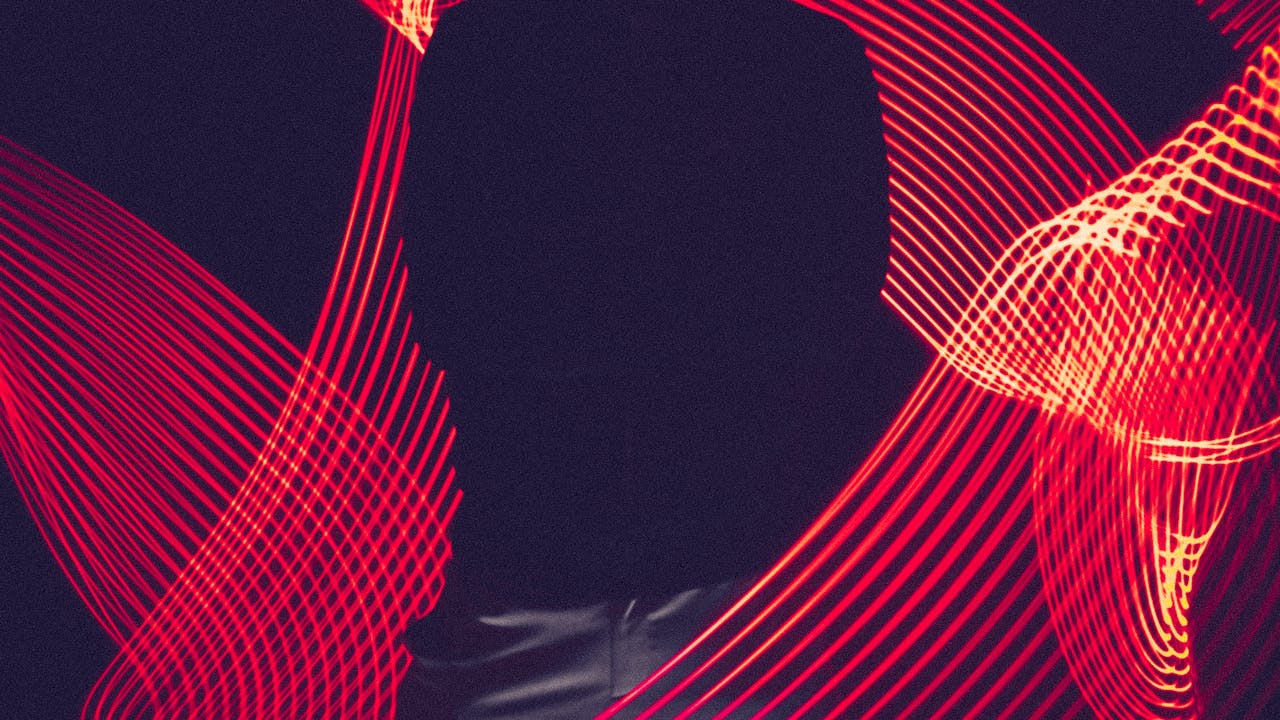
Camera settings for abstraction. Slow shutter speeds (1/10 second or slower) combined with intentional movement create motion blur. Long exposures (several seconds) combined with LED light painting create light trails. Wide-angle lenses (24mm or wider) distort facial features when held close to the face. Fisheye lenses exaggerate perspective to an extreme degree.
Physical interventions. Shooting through water, prisms, frosted glass, or textured transparent materials changes what the sensor records before any editing happens. Multiple mirrors create fragmented, reflected, or infinite self-portraits. Projecting patterns or light onto your face while photographing creates images that can't be reproduced through any other method.
Digital editing as abstraction. Apps like Prisma and DeepArt apply neural-style transfer, converting your photograph into the visual language of Van Gogh, Munch, Picasso, or other artists. More sophisticated editing in Photoshop or Procreate allows you to combine multiple exposures, paint over photographs with digital brushes, apply radical color shifts, and composite elements from different images.
The appeal of abstract self-portrait photography is that it meets you where you are. If you have a smartphone, you can start today. No supplies. No setup. No artistic training required.
Connecting abstract self portraits to Fable's portrait tradition
There's a throughline connecting the abstract self-portrait tradition to what Fable does.
Every abstract self-portrait, at its core, asks: what is the most truthful representation of a person? Not the most accurate. The most truthful. Picasso's answer was to show multiple angles at once. Kahlo's answer was to surround the self with symbolic objects. Basquiat's answer was to layer marks, text, and symbols over a barely-visible face.
Fable's answer is classical portraiture. The old masters' approach to portraits was never purely photographic even when photography didn't exist. They made decisions: about lighting, about pose, about costume, about what the sitter's face said in a moment of quiet dignity. A Fable family portrait or Fable couple portrait applies the same logic. The subject is real. The rendering elevates that reality into something timeless.
A custom Fable portrait is, in its own way, an abstract self-portrait. It takes your face and renders it not as you appear in a casual photograph but as you might have appeared to a 16th-century master who believed portraiture was the highest form of painting. That's a kind of abstraction. The best kind.
Notable exhibitions and the current state of self-portrait art
Abstract self-portraiture isn't only a historical tradition. It's thriving right now.
The Smithsonian's National Portrait Gallery ran "The Outwin 2025: American Portraiture Today" in 2025, featuring 34 works in mediums including painting, photography, sculpture, and immersive time-based installations. The exhibition emphasizes the continuing vitality of the self-portrait as a form.
Paula Modersohn-Becker, the German Expressionist who created the first known nude self-portraits by a woman, received her first U.S. museum retrospective at MoMA and the Neue Galerie New York. The retrospective introduced American audiences to a body of work that had remained largely unknown outside Germany.
Everlyn Nicodemus's 1982 five-faced self-portrait entered the London National Portrait Gallery's permanent collection. The work explores diasporic identity as a Black woman through multiple overlapping faces in the Cubist tradition.
Jenny Saville's first major U.K. museum exhibition featured 50 works, including her large-scale portrait paintings that push the boundary between representation and abstraction through thick, tactile paint layers that transform flesh into something almost sculptural.
The portrait is in good health. Abstract self-portraiture, specifically, has never had more cultural space or institutional support.
Where to look for more
Learning abstract self-portraiture is partly a matter of technique and partly a matter of looking at a lot of art. A few resources worth knowing:
The Georgia Museum of Art has published free instructions for their "Art at Home: Abstract Self-Portraits" program, designed for all ages and skill levels. Syracuse University Art Museum offers a well-documented "Abstract Self-Portrait Collage" exercise that has been used in educational settings.
For the painting tradition, the book "Mixed-Media Self-Portraits: Inspiration and Techniques" by Cate Coulacos Prato covers collage, painting, and mixed-media approaches in depth. For photography, Canon Europe's guide to abstract portrait photography covers the main techniques in accessible detail.
For inspiration through art history, the National Portrait Gallery's Google Arts & Culture collaboration "Eye to I: Self-Portraits from 1900 - Today" provides a broad survey of abstract and experimental self-portraiture across the 20th and 21st centuries, freely accessible online.
Abstract self portrait ideas for different occasions
Abstract self-portraiture can be connected to specific life moments in ways that make the work more meaningful.
Milestone birthdays. A 30th, 40th, or 50th birthday is a natural inflection point for self-examination. An abstract self-portrait made at a milestone age is a record of who you were at that moment, captured in a medium more expressive than a photograph.
Major transitions. Moving to a new city, ending a relationship, changing careers, becoming a parent. These transitions change who you are. An abstract self-portrait made during or after a transition can help you process what changed.
Annual practice. Some artists make a self-portrait every year as an ongoing record of their inner life. The cumulative effect over a decade or more is a kind of visual autobiography that no other medium produces.
Therapeutic context. Art therapists use self-portraiture specifically to help clients who are processing trauma, managing anxiety, or working through identity questions. If you're in therapy or considering it, discussing self-portrait work with your therapist can be valuable.
For milestone occasions where you want a portrait that will last for generations, Fable's birthday portrait gifts and anniversary portrait options offer an immediately meaningful alternative to a DIY project. The Fable pricing page shows what's available for different budgets.
Frequently asked questions
What is an abstract self portrait?
An abstract self portrait is any artwork where the artist depicts themselves without strict photorealistic accuracy. The level of abstraction can range from mild stylization to pure gesture with no recognizable facial features. The defining element is that the creator and subject are the same person, and the work prioritizes expressive or symbolic truth over accurate likeness.
How do you make an abstract self portrait for beginners?
The collage method is the most accessible starting point. Collect magazine images and colored paper scraps, print a black-and-white photograph of yourself, and reassemble your face from the torn materials on a backing board. Add painted lines or color washes over the collage to pull it together. This approach requires no drawing or painting skill and can be done in an afternoon.
What materials do I need for an abstract self portrait?
For painting: canvas, acrylic paints in basic colors, flat and round brushes, palette knife. Budget: $40 to $80. For collage: backing board, magazines, glue or gel medium, optional acrylic paints. Budget: $10 to $30. For photography: a smartphone and free editing apps. Budget: $0 to $20.
Who are the most famous abstract self portrait artists?
Pablo Picasso, Frida Kahlo, Jean-Michel Basquiat, Salvador Dali, Egon Schiele, Francis Bacon, Lucian Freud, and Andy Warhol are the canonical examples. Each worked in a distinct tradition ranging from Cubism and Surrealism to Pop Art and Neo-Expressionism.
Is abstract self portraiture good for mental health?
Research suggests yes. Studies published in the European Journal of Psychotherapy and Counselling and reviewed in PubMed Central confirm that self-portraiture, regardless of skill level, reduces state anxiety, improves self-awareness, and provides a non-verbal outlet for emotions that are difficult to articulate verbally. Abstract approaches specifically allow emotional expression at a safe distance from literal self-depiction.
What is the difference between a self-portrait and an abstract self portrait?
A self-portrait is any depiction of the artist by themselves. It can be realistic or abstract. An abstract self-portrait is specifically a self-portrait that moves away from accurate representation toward expressive, symbolic, or fragmented imagery. The difference is one of approach: a realistic self-portrait aims for likeness; an abstract self-portrait aims for emotional or conceptual truth.
How long does it take to make an abstract self portrait?
A collage self-portrait can be completed in two to four hours. An acrylic painting takes a day or more depending on drying time and the number of layers. A photographic abstract self-portrait can be created and edited in an hour if you have the techniques ready. Most artists find that the work takes as long as it needs to take, which is usually longer than the initial plan.
Can I commission an abstract style portrait if I don't want to make one myself?
Yes. Fable's custom portrait service creates museum-quality portraits from your photographs in classical and renaissance styles. If you want something that feels like fine art without making it yourself, check how it works and the Fable pricing page.
Related guides
- Abstract portraits: styles, history, and ideas
- Self-portrait art: how to use a drawer and create your own
- Custom portrait gifts for any occasion
- Fable self portraits
- How Fable works
Sources
- Beyond the face: Art therapy and self-portraiture (ScienceDirect)
- Role of Art Therapy in the Promotion of Mental Health (PMC/NCBI)
- The Outwin 2025: American Portraiture Today (National Portrait Gallery)
The most honest portrait of you doesn't have to look like you at all. It just has to be true.
Whether you spend an afternoon making something with your own hands or upload a photograph to Fable and receive a painting that belongs in a museum, the act of creating a portrait of yourself is the act of saying: I was here. I looked. I tried to show what I found.
That's worth doing. Start now.